


Rental Housing Comparison: Will County vs. Kankakee County, Illinois
Across the Chicagoland region, rental housing costs vary widely depending on proximity to Chicago, job access, and development growth. Two counties that highlight this difference clearly are Will County and Kankakee County. While both are located in northeastern Illinois, their rental markets tell two very different stories, one shaped by suburban expansion and commuter demand, the other by affordability and small-city living.
The Big Picture: Two Different Housing Markets
Will County sits directly within the Chicago metropolitan orbit, making it one of the fastest-growing suburban regions in Illinois. Its proximity to major highways, rail lines, and employment hubs has fueled consistent demand for rental housing. As a result, rents in the county tend to reflect suburban Chicago pricing rather than rural Illinois averages.
In contrast, Kankakee County operates in a more affordable, small-city housing market. With lower population density and less intense commuter demand, rental
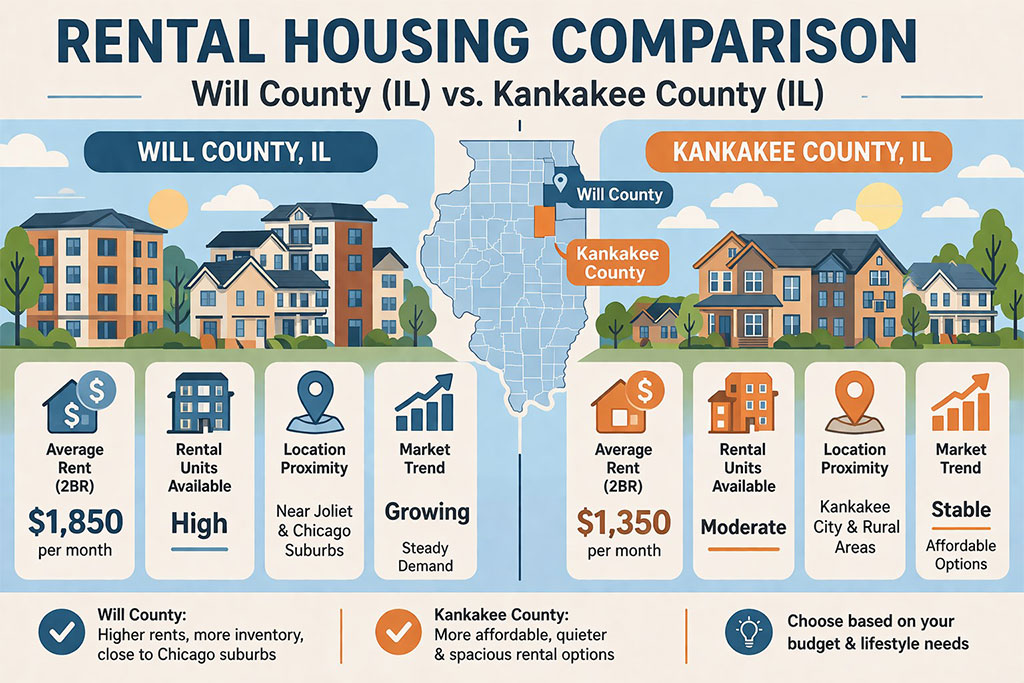
prices remain significantly more accessible for working families, retirees, and local residents.
Rental Cost Differences
One of the most noticeable differences between the two counties is price.
In Kankakee County, average rent typically falls around the $1,100–$1,300 range, depending on unit size and condition.
In Will County, rents are considerably higher: 1-bedroom units often range around $1,500+ and 2–3 bedroom homes can exceed $1,800–$2,400 plus.
This means renters in Will County often pay 40% to 70% more than those in Kankakee County for similar living space.
Housing Availability and Style
Will County
Rental options in Will County tend to include: newer apartment complexes, suburban townhomes, master-planned communities and higher-end amenities (fitness centers, pools, updated finishes). Because of ongoing development, renters often find modern units, but competition can be strong, especially near commuter-friendly cities like Joliet and New Lenox.
Kankakee County
Rental housing in Kankakee County is typically: Older but more spacious single-family homes, duplexes and small apartment buildings, lower-density neighborhoods, more affordable long-term rental options. While there are fewer luxury developments, renters often get more space for the price and less competition when applying.
Location & Lifestyle Impact
Location plays a major role in the rental gap between the two counties. Will County benefits from direct access to Chicago employment centers. Many residents commute daily, which increases demand and drives up rent. Kankakee County offers a slower-paced lifestyle with longer commutes to major job hubs but significantly lower housing costs.
Pros and Cons for Renters
Will County Pros: Close to Chicago job market, more modern apartments and developments, and strong infrastructure and transportation.
Will County Cons: Higher rent prices, competitive rental market, and higher overall cost of living
Kankakee County Pros: Much lower rent costs, more space for the price and easier rental approvals in many cases.
Kankakee County Cons: Fewer luxury or new developments, longer commute times to major cities and limited high-end rental inventory.
Choosing between Will County and Kankakee County ultimately comes down to priorities. If you want affordability, space, and lower monthly expenses, Kankakee County is the stronger option. If you prioritize location, commute convenience, and newer housing, Will County offers more advantages, at a higher price.
Both markets serve very different needs within Illinois’ housing landscape, and understanding those differences can help renters make smarter financial and lifestyle decisions.